
Home Again
With Thoughts on the French Revolution

It is 0329 hrs. on the morning of 14 May, and I have been home for six hours. Jet lag has me in its infernal clutches, as I awoke with a start twenty-nine minutes ago and all I could think of is the taste of my house brand coffee. I decided that as an all-grown-up-retiree, I can get up at any time I want, and I can nap any time I want, so I will not be confined to traditional views of when a man should be abed and when he should wake. I did manage three hours of actual sleep according to my trusty Ring of Power, and that was after bagging 2.5 yesterday afternoon (at least that's what my Greece body clock told me) on the flight home. The funny thing is, over dinner last night with the Kitten and friend Robert near Reagan Airport, he--someone who's been to see his son in Germany several times in the last few years (grad student)--opined that his first night back he would wake up at--you guessed it--0300 (which is exactly what the clock said when I looked at it).
I am reclined in bed, looking out into the blackness of my yard, trusty cat beside me and fortified by the day's first cup. I am aware there is a bill to be paid for the disordering of my circadian rhythms, and I am getting on with the punishment.
As for the journey home, it was very smooth. Ride to the airport, on time. Security at first airport, quick. Free airport shuttle to hotel in Athens, available. Restaurant near hotel without one, walkable. Free airport shuttle to airport, on time. Lux lounge to while away a bit of time, provided. Flight to Dulles, without incident. Metro from Dulles, predictable. Pickup, dinner, drive home. All as planned.
Thinking About The French Revolution
Before reading this portion, I should get two things out of the way. First, I am no expert on the French Revolution. Second, I am CERTAIN that what I bring up here has been done much better by others, elsewhere. That said:
My second favorite podcast is called “The Rest is History" (the first is of course, “The History of the Americans"), and I spent a great deal of time listening to it during my long walks in the past month. The show features two Brit history professors, one mostly a classicist, the other mostly studies the 21st century. They are sharp, really quite funny, and work well together. They have put out shows for a number of years, and as I am listening to them in the order they were recorded, I am still several years behind. As it happens, the last few runs and walks I went on were accompanied by a series of shows devoted to the coming of the French Revolution.
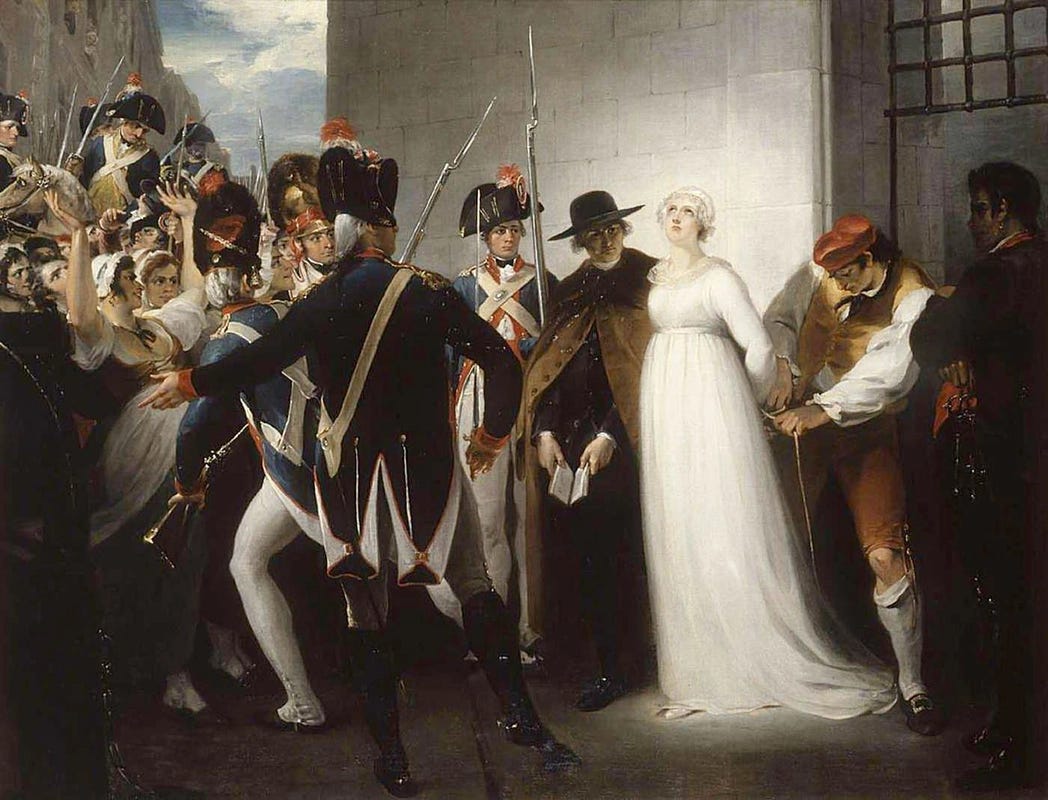
Revolutions are in the news these days, what with the 250th Anniversary of our own just two months hence. I was a living, breathing being in 1976 when we celebrated our 200th, and for some reason, I felt like that was a bigger deal. Not to me, mind you, but to the country. I remember watching New Years Eve 1975 programming as a precocious 10-year old, and it was all about our “Bicentennial Year". As a fifth (?) grader, we were exposed to all manner of learning about our great country and its birth. I wonder if today's 11 year old’s are getting that.
Never mind that. I am writing this because I tried to write it first as a multi-tweet series on Twitter, but intermittent internet on the airplane conspired against my pulling it off artfully. So I return to this line of thought here. Back to those English guys.
The podcasters, Professors Dominic Sandbrook and Tom Holland, are very likeable, save for one slightly irritating tic. They are mildly anti-American. Not full out mind you, they give us our due, and there are a lot of things about America that they respect, but their commentary is suffused with a certain low-grade animus and high-brow derision. Some is clearly for kicks. Some isn’t. Part of the issue is that they are both thoroughly patriotic Brits, and the circumstances of this nation’s birth seem not to sit well with them. Nor I suspect—for at least one of them—has America’s role in the world in the past few decades been admirable.
When they began to introduce the topic of the French Revolution, they became positively gooey with admiration for the “importance” of the French Revolution, concluding that it was more important than their own Glorious Revolution, our revolution against them, or the Russian Revolution. Every year--on Bastille Day (July 14th), Frenchmen (and English history dons) celebrate the French Revolution, this incredibly important event, without any real consideration of the fact that as revolutions go, it was an abject failure. What do I mean?
First of all, it was repulsively and unnecessarily blood-thirsty. To their credit, Sandbrook and Holland (remember--I really like these guys and this show), make no bones about this. But any inquiry into the “Republic" and the revolution that spawned it has to account for this.
More importantly though, when judging “importance", one has to overlook a very inconvenient fact about the French Revolution. An absolute monarch and his wife were murdered and the result was so unstable that an Emperor took power who plunged the continent into continuous war. In other words, the Revolution failed. The Republic in the middle was an utter train wreck and failure, and rather than evolve THAT government into something lasting and influential (see, “Revolution, American"), French society doubled down on monarchy.
Ah, you’re saying, scholars don’t adore the French Revolution for its prosaic impact on French government. No, silly, that is far too limiting for the grandeur of the event. The French Revolution re-ordered European society, created the modern nation state, and signaled the end of the feudal order in Europe! It is important because of the knock on/trickle down effects. If the Glorious Revolution were more important, it would have lit the fire of revolution in Europe. But it didn't. If the American Revolution were more important, it would have been more causal in overturning the established order in Europe. But it didn't. It took THE FRENCH REVOLUTION to destroy the established order in Europe, and that is why it is so important.
I disagree. It strikes me that there are few ideological first principles created by the French Revolution, with the sole exception being that terror in the pursuit of political gain. Don't give me this “Rights of Man" stuff. That the “Rights of Man" codifies these rights does not mean it invented them. Yes, I know. The Bill of Rights comes after the “Rights of Man", but the Constitutional convention, its ratification, and the HUGE public debate over the lack of a Bill of Rights--mostly preceded the French document. That one of the loudest voices criticizing the Constitution's failure to include a Bill of Rights was America's Ambassador to France--Thomas Jefferson (who helped shape the “Rights of Man") further solidifies the cribbed nature of the French document. The positive ideological impact, of the French Revolution-is borrowed from the British and their American offspring. And once the British and Americans overturned the concept of sovereignty deriving from anywhere other than the people, all that was left was twenty five years of disorder, murder, and war that were not completely settled until World War I for the rest of Europe to get the message. If we are measuring the importance of the French Revolution based on the forces it unleashed on Europe, then surely it was the activities of Napoleon that created these effects, because the ideas (which his reign in many cases, repudiated) were borrowed.
Ultimately, I suspect this is all attributable to Eurocentrism, that the French Revolution was important because it happened in France, because it happened in Europe. But as I reflect upon the revolution in my native country in 1776 and the blessings it bestowed not only on our people but in subsequent generations worldwide who have been the beneficiaries of the system it created, I have a hard time agreeing with Professors Sandbrook and Holland that the French Revolution was more important.
Summary Reflections on the Cretan Odyssey
My recent month-long solo trip to Chania, Crete was never about going to Chania, Crete. It was about testing a theory by conducting an experiment. That experiment is over, and summary findings are available.
To remind, I had been frustrated in previous travel with the concept of moving from place to place and never unpacking. I desired to go somewhere and “burrow in" (my phrase) to a locality, and really experience somewhere on an elemental level. A difference in how such a trip would be conducted led The Kitten to suggest I go by myself, and so the Walden-like concept of splendid isolation was born. Bottom line up front? The theory was better than the reality.
It was a wonderful trip. I am glad I went, I had a splendid time, I ate tasty food, saw a bit of the surrounding countryside, had a bit of culture, and lost eleven pounds while exercising like a fiend. I returned to the United States in better health with some rare (for me) evidence of having been in a sunny place.
Thirty days was a good length of time. I definitely got lonely toward the end, and was really glad to get on that plane in Athens to come home.
Chania was the wrong place to go. Keen readers will remember the discussion with The Kitten that led to this trip having sprung from her desire to go someplace that we could make day trips elsewhere from. This struck me as inconsistent with the “burrowing in” concept, and so the solo trip was born. I chose Chania based on faded thirty-five year old memories, and it turned out to be a poor choice. Not because it isn't delightful, but because both the nature of the experiment and the geography of Crete conspired against it. Truthfully, Catherine's idea of a hub and spoke approach (have a place to strike out from) turned out to be far more in alignment with my desires than the whole “burrowing in" approach. This is because Chania's charms held up for a week or so, but it is relatively small place that caters to weekend tourists. I found myself (as I admitted here) wishing I could hop on a train and head over to some other wonderful experience. There are other places in Crete, but there are no trains, and they are--for better or worse--pretty much smaller versions of Chania. I could have rented a car, but to what end? To see another charming little coastal town? Had I selected a little French village served by rail, I could have had the isolation I sought (or thought I sought) and the means to shake things up.
I did not “burrow in". The (beautiful, well-appointed, comfortable) apartment I rented was in a neighborhood that was not conducive to “burrowing". Surrounded by lots of other buildings with temporary lodging that was mostly empty as the high season had not started, there was no real neighborhood to burrow into. I discussed in earlier essays that little mini-mart down the street, but that was the extent of things in that neighborhood, and no one in the mini-mart seemed all that interested in yet another transient who stayed a bit longer than usual.
Greek indifference. I got home the other day, and yesterday, I went for a six mile walk on the rail to trail here in Easton. I passed many people moving in the other direction, and to a person, they nodded, waved, said “hello" or “good morning", or otherwise in some manner exchanged greetings. This simply did not happen in Crete. I walked SCORES of miles at all times of day, and the locals (because I was walking in a lot of non-tourist areas) had little interest in even turning their head or lifting it from the sidewalk. I am not trying to say the Greeks are bad people or that they are unfriendly, but the general atmosphere--probably driven by my choice of a tourist town--was not warm.
I missed Catherine. I was thousands of miles and seven time zones removed from the central organizing principle of my life for thirty days, and that was unpleasant. Her busy life went on as normal when I left, or more to the point, it got even busier. I knew I would miss her, but I had not mentally prepared for how the seven hour time difference would intensify my self-imposed isolation. For whatever reason, I just figured we'd have a bunch of video chats and everything would be great. But for a good deal of the day, our waking and sleeping times were so out of phase as to really limit the windows for such things, and when we were both conscious, there was her busy life to contend with. Bottom line, the splendid isolation itch was scratched. I do not think I'll undertake a solo trip of this nature again.
That's it. A great experience that taught/retaught me things about myself and the world around me.
French Revolution was a disgusting moment in history, far too highly rated, and lefty pundits and professors who gush and ooze over the beauty of it truly, deeply need to understand -- on a human level -- what that infernal moment did. They love reading about it, centuries and an ocean away. They would not have enjoyed living through it
Your thoughts on the French Revolution reminded me of the famous quote attributed to Zhou Enlai, that it was (in 1972) "too early to tell" the impact of the French Revolution. I dug in a bit, however, and learned that story derives from a misunderstanding. Only just now did I learn that Zhou was apparently referring to the uprising of French students and the general strikes of 1968, only four years before! That makes a lot more sense.